
Editorial 2 articles

The landscape of kidney cancer treatment is in a state of rapid evolution. This editorial reflects on key breakthroughs from GU ASCO 2026 and their implications for clinical practice.
The landscape of kidney cancer treatment is in a state of rapid evolution. This editorial reflects on key breakthroughs from GU ASCO 2026 and their implications for clinical practice.

This quarter’s selection highlights landmark studies in first-line combination immunotherapy and biomarker-driven patient selection for adjuvant therapy in localized RCC.
This quarter’s selection highlights landmark studies in first-line combination immunotherapy and biomarker-driven patient selection for adjuvant therapy in localized RCC.
Review Article 1 article

BACKGROUND AND OBJECTIVE: Small renal masses (SRMs), defined as enhancing renal lesions ≤4 cm (clinical stage T1a), represent a biologically heterogeneous group of tumors. While many SRMs are benign or indolent, a subset harbor aggressive potential, and current imaging modalities cannot reliably distinguish these subgroups. This narrative review summarizes the current evidence for molecular and genomic biomarkers in SRM risk stratification and evaluates their potential clinical role. METHODS: A structured search of PubMed/MEDLINE from January 1, 2000 through January 1, 2026 was performed using terms related to small renal masses, molecular and genomic biomarkers, and prognostic outcomes. Reference lists of relevant studies and clinical guidelines were also reviewed. RESULTS: Gene expression signatures, including ClearCode34 and a 16-gene recurrence assay, can distinguish indolent from aggressive clear cell renal cell carcinoma and are compatible with formalin-fixed biopsy tissue. Somatic alterations in genes such as VHL, PBRM1, BAP1, and SETD2 define biologically distinct tumor subtypes, with BAP1 loss detectable by immunohistochemistry on renal mass biopsy specimens. Chromosomal alterations, including 9p loss, correlate with higher-grade disease and metastatic potential. Emerging liquid biopsy approaches demonstrate promise but remain incompletely validated in SRM populations. CONCLUSIONS: Although molecular and genomic biomarkers have substantially advanced understanding of renal cell carcinoma biology, none are currently incorporated into routine clinical management of small renal masses. Most candidate biomarkers have been developed in nephrectomy cohorts and lack prospective validation in renal mass biopsy specimens or active surveillance populations. Future studies integrating molecular biomarkers with clinical and radiographic data in SRM-specific cohorts are needed before these tools can meaningfully inform patient care.
BACKGROUND AND OBJECTIVE: Small renal masses (SRMs), defined as enhancing renal lesions ≤4 cm (clinical stage T1a), represent a biologically heterogeneous group of tumors. While many SRMs are benign or indolent, a subset harbor aggressive potential, and current imaging modalities cannot reliably distinguish these subgroups. This narrative review summarizes the current evidence for molecular and genomic biomarkers in SRM risk stratification and evaluates their potential clinical role. METHODS: A structured search of PubMed/MEDLINE from January 1, 2000 through January 1, 2026 was performed using terms related to small renal masses, molecular and genomic biomarkers, and prognostic outcomes. Reference lists of relevant studies and clinical guidelines were also reviewed. RESULTS: Gene expression signatures, including ClearCode34 and a 16-gene recurrence assay, can distinguish indolent from aggressive clear cell renal cell carcinoma and are compatible with formalin-fixed biopsy tissue. Somatic alterations in genes such as VHL, PBRM1, BAP1, and SETD2 define biologically distinct tumor subtypes, with BAP1 loss detectable by immunohistochemistry on renal mass biopsy specimens. Chromosomal alterations, including 9p loss, correlate with higher-grade disease and metastatic potential. Emerging liquid biopsy approaches demonstrate promise but remain incompletely validated in SRM populations. CONCLUSIONS: Although molecular and genomic biomarkers have substantially advanced understanding of renal cell carcinoma biology, none are currently incorporated into routine clinical management of small renal masses. Most candidate biomarkers have been developed in nephrectomy cohorts and lack prospective validation in renal mass biopsy specimens or active surveillance populations. Future studies integrating molecular biomarkers with clinical and radiographic data in SRM-specific cohorts are needed before these tools can meaningfully inform patient care.
Meeting Summary 1 article
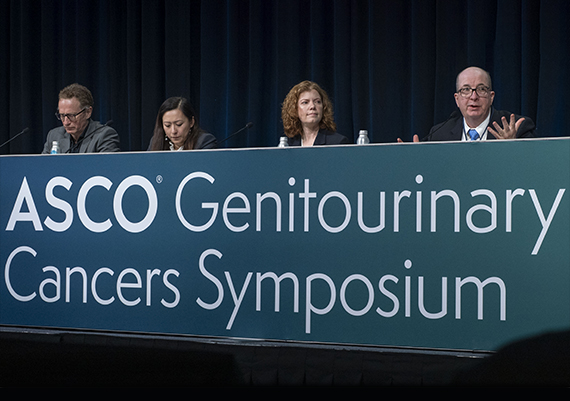
The 2026 ASCO Genitourinary Cancers Symposium (GU26), held February 26– 28 in San Francisco, California, showcased pivotal advances in kidney cancer spanning trial readouts, biomarker research, and emerging therapeutic strategies. Two late-breaking phase III readouts headlined the meeting, both evaluating belzutifan, an oral HIF-2α inhibitor. LITESPARK-022 demonstrated superiority of belzutifan plus pembrolizumab over pembrolizumab alone in the adjuvant high-risk clear cell RCC (ccRCC) setting — a first for any combination in adjuvant solid tumor oncology. LITESPARK-011 established belzutifan plus lenvatinib as a superior post-immunotherapy option over cabozantinib in advanced ccRCC, the first phase III superiority result in this context. Collectively, these results position HIF-2α inhibition as an emerging cornerstone across the RCC treatment continuum. Frontline therapy updates reinforced the durability of immunotherapy-based combinations, with individualized regimen selection — balancing efficacy, toxicity, and patient preferences — emerging as a central principle. In the adjuvant space, patient-reported outcome data from RAMPART added important quality-of-life context. A notable finding was the lack of benefit from adjuvant pembrolizumab in nonclear cell RCC, highlighting the need for dedicated histology-specific trials in this underserved population. Biomarker development and emerging strategies — including radiation as an immune sensitizer and novel mechanistic combinations — pointed toward the field’s next frontiers. GU26 signaled a new era of therapeutic sophistication in RCC, with patient selection, biomarker validation, and inclusive trial design as defining priorities ahead.
The 2026 ASCO Genitourinary Cancers Symposium (GU26), held February 26– 28 in San Francisco, California, showcased pivotal advances in kidney cancer spanning trial readouts, biomarker research, and emerging therapeutic strategies. Two late-breaking phase III readouts headlined the meeting, both evaluating belzutifan, an oral HIF-2α inhibitor. LITESPARK-022 demonstrated superiority of belzutifan plus pembrolizumab over pembrolizumab alone in the adjuvant high-risk clear cell RCC (ccRCC) setting — a first for any combination in adjuvant solid tumor oncology. LITESPARK-011 established belzutifan plus lenvatinib as a superior post-immunotherapy option over cabozantinib in advanced ccRCC, the first phase III superiority result in this context. Collectively, these results position HIF-2α inhibition as an emerging cornerstone across the RCC treatment continuum. Frontline therapy updates reinforced the durability of immunotherapy-based combinations, with individualized regimen selection — balancing efficacy, toxicity, and patient preferences — emerging as a central principle. In the adjuvant space, patient-reported outcome data from RAMPART added important quality-of-life context. A notable finding was the lack of benefit from adjuvant pembrolizumab in nonclear cell RCC, highlighting the need for dedicated histology-specific trials in this underserved population. Biomarker development and emerging strategies — including radiation as an immune sensitizer and novel mechanistic combinations — pointed toward the field’s next frontiers. GU26 signaled a new era of therapeutic sophistication in RCC, with patient selection, biomarker validation, and inclusive trial design as defining priorities ahead.
Selected Presentations 1 article

This document presents full abstract summaries for the ten kidney cancer abstracts selected by the Editor-in-Chief as the most clinically significant presentations from GU ASCO 2026. Each entry includes background, methods, key results, safety profile, and editorial perspective. Abstracts are ordered by assigned rank from the editorial selection. Primary data are drawn from presentations, published JCO supplement abstracts, press releases, and peer-reviewed commentary.
This document presents full abstract summaries for the ten kidney cancer abstracts selected by the Editor-in-Chief as the most clinically significant presentations from GU ASCO 2026. Each entry includes background, methods, key results, safety profile, and editorial perspective. Abstracts are ordered by assigned rank from the editorial selection. Primary data are drawn from presentations, published JCO supplement abstracts, press releases, and peer-reviewed commentary.